
What a Certificate of Analysis (COA) Proves for a Research Peptide (and What It Doesn't)
Last updated:
A peptide COA proves three things about one specific lot: that the measured molecular mass matches the expected sequence (identity), what share of the UV-detected material is the target peptide (HPLC purity), and, when tested, how much bacterial endotoxin is present. It does not prove that your vial came from that lot, that the powder is all peptide by weight, that the amino acids are in the right order, or that the material is unchanged since the test date. Read a COA as a lot-level analytical record, then verify it against the vial in your hands.
Below: how to read a peptide COA from top to bottom, how the underlying peptide testing works, and how to confirm a report with the lab that issued it.
What is a certificate of analysis for a research peptide?
A certificate of analysis (COA) is a report issued by a testing laboratory that records the analytical results for one specific production lot, linked to that lot by its lot or batch number.
A certificate of analysis for peptides comes either from the manufacturer's quality control lab or from an independent third-party lab testing a sample submitted by the seller. A third-party COA carries more weight because the lab has no stake in the result. It covers only the sample tested from that lot, and only the tests listed.
A specification states what a product is supposed to meet; a COA records what one lot actually measured. "High purity" on a product page is a claim. A COA with a chromatogram, a mass spectrum and a lot number is evidence.
Why does peptide testing matter for in-vitro research?
Most synthetic peptides are made by solid-phase peptide synthesis (SPPS), which generates impurities that closely resemble the target molecule: deletion sequences (a missing amino acid), insertion sequences (an extra one), racemized residues, leftover protecting groups, oxidized side chains and residual counterions such as trifluoroacetate (TFA) (D'Hondt et al., 2014).
That review, in the Journal of Pharmaceutical and Biomedical Analysis, notes these impurities can influence early functionality studies and lead to erroneous conclusions. If a lot contains a meaningful fraction of a truncated or modified sequence, an assay may be measuring a mixture rather than the compound on the label. The COA is where the evidence against that risk is recorded.
What does a peptide COA actually prove?
A research peptide COA rests on two core tests, HPLC and mass spectrometry, sometimes with content and endotoxin testing added.
Identity: does the molecule have the right mass?
Mass spectrometry identity testing confirms that the measured molecular mass of the sample matches the mass calculated from the peptide's amino acid sequence. It is often run as LC-MS, where liquid chromatography feeds the sample into the mass spectrometer. Electrospray ionization can give one molecule one, two or more charges, so several labeled peaks may point to a single mass. A deletion or insertion sequence shifts that mass by the weight of the missing or extra residue, so a wrong main product shows up here.
Purity: how much of the detected material is the target peptide?
HPLC purity is the percentage of the total integrated peak area in a chromatogram that belongs to the main peptide peak. Peptides are usually analyzed by reversed-phase HPLC with UV detection around 214 to 220 nm, where peptide bonds absorb. The result is relative, and only as reliable as the method's ability to separate impurities from the main peak. FDA's Q2(R2) guidance describes how a lab shows an analytical method is fit for purpose, including specificity, accuracy, precision and robustness (FDA, Q2(R2)).
Endotoxin: is bacterial contamination below a stated level?
Endotoxin testing measures bacterial lipopolysaccharide contamination and usually reports the result in endotoxin units per milligram (EU/mg). The methods in USP chapter <85>, Bacterial Endotoxins Test, include gel-clot and photometric (turbidimetric or chromogenic) techniques, and FDA's endotoxin testing guidance references that chapter (FDA, Pyrogen and Endotoxins Testing: Questions and Answers). For in-vitro work it matters because lipopolysaccharide can activate many cell types in culture and confound cell-based assays. No endotoxin line means not tested, which is different from a result of zero.
What doesn't a COA prove?
A COA does not prove:
- That your vial is from the tested lot. The only link is the lot number. If the vial label and the COA differ, the report describes other material.
- That the powder is all peptide. HPLC purity ignores water, salts and counterions such as TFA. Net peptide content is the share of a lyophilized powder's weight that is actually peptide, and it is a separate measurement.
- That the sequence order is correct. The same amino acids in a different order, or a D-isomer in place of an L-isomer, have the same mass. Tandem MS (MS/MS) fragmentation adds sequence-level evidence.
- That every impurity was detected. An impurity that co-elutes with the main peak, or does not absorb at the chosen wavelength, is invisible to that method.
- That your vial is unchanged or holds the labeled amount. A COA is a snapshot of the tested sample on the report date.
- Sterility or biological activity, unless those tests appear on the report.
- Suitability for anything beyond laboratory research. A COA is an analytical record, not a safety assessment or regulatory approval.
How do you read a peptide COA from top to bottom?
Layouts vary by lab, but most research peptide COAs contain the fields below, roughly in this order. Use the third column as a checklist.
| COA field | What it means | What to check |
|---|---|---|
| Laboratory | The lab that ran the tests | Named, with contact details you can find independently |
| Lot number | The production lot the report covers | Matches the lot printed on your vial exactly: one lot, one certificate |
| Received and reported dates | When the lab received the sample and issued results | Both present and plausible |
| Product | The compound and the labeled amount | Matches your vial and the product listing |
| Purity (HPLC-UV) | Share of UV-detected peak area in the main peak | A percentage backed by an attached chromatogram |
| Identity (LC-MS) | Observed mass compared with the theoretical mass | Reads as confirmed, with mass values or labeled peaks shown |
| Appearance | What the lab saw, such as a white lyophilized powder | Matches the material you received |
| Net content | Peptide in the tested vial (mg), or share of powder weight that is peptide (%) | Units stated, so you know which it reports |
| Chromatogram | The purity trace | One dominant peak; impurities appear as smaller peaks |
| Mass spectrum | The identity evidence | Labeled peaks match the expected mass, often as singly and doubly charged ions |
| Endotoxin (if listed) | Lipopolysaccharide level in EU/mg | Method named, numeric result given |
| Signature | Approval by a named chemist or analyst | Name, role and lab contact details; QR code if offered |
Why do COAs from different labs look different?
Each lab uses its own template and wording ("net content" or "peptide content", for example). Layout does not affect validity: every credible report names the laboratory, lot and product, and reports purity, usually with identity. A trustworthy summary of a COA, such as a lot card on a product page, shows only results the lab actually reported, never values for tests that were not run.
How do you verify a COA?
The one-minute check against your vial
- Find the lot number printed on your vial label.
- Look it up in the seller's COA library.
- Match the details: product and size match your vial, identity reads as confirmed, and purity matches the figure the listing shows.
Confirming a COA with the issuing lab
- Find the lab independently, not through a link inside the PDF.
- Scan the QR or verification code if one is printed, and confirm it opens on the lab's own domain.
- Contact the lab with the report number or sample ID and the lot number, and ask it to confirm the product, lot and results.
- Read the raw data (chromatogram and mass spectrum), not only the summary numbers.
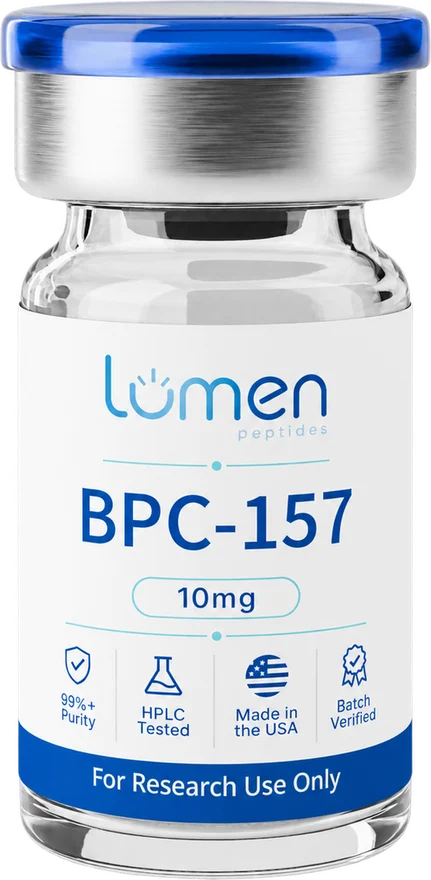
Lumen publishes a third-party COA for every lot in its COA library, so researchers can run both checks before ordering from the research peptide catalog. The same applies to a single listing such as the BPC-157 research peptide page: identify the lot, open its COA, and read it against the field table.
What are the red flags on a peptide COA?
- No lot number, or one lot number reused across different products.
- A purity figure with no chromatogram attached.
- An identity claim with no mass data behind it.
- No named laboratory, or a lab you cannot find or contact on your own.
- A QR code that opens on a domain other than the lab's.
- Identical chromatograms, sample IDs or dates on reports for different lots.
- A reported HPLC purity of exactly 100%, which is unusual for a synthetic peptide that almost always carries some related impurities.
- Mismatched fonts or misaligned values that suggest editing.
- A "third-party tested" label with no lab named.
None of these alone proves a report is false, but each breaks the chain of evidence.
Frequently asked questions about peptide COAs
What is a peptide COA?
A peptide COA is a lab report recording identity, purity and sometimes endotoxin results for one production lot, linked to that lot by its lot number.
Is HPLC purity the same as net peptide content?
No. HPLC purity measures the main peak as a share of all UV-detected peaks. Net peptide content measures how much of the powder's weight is peptide rather than water, salts and counterions. A lot can have high HPLC purity and a lower net peptide content.
Does mass spectrometry confirm the peptide sequence?
Not fully. Standard MS confirms molecular mass, which rules out most deletion and insertion errors, but cannot distinguish reordered sequences or D- and L-isomers. Tandem MS (MS/MS) adds sequence evidence.
How do I know a COA belongs to the vial I received?
Compare the lot number on the vial label with the lot number on the COA. If they match exactly and the issuing lab confirms the report, the COA describes your lot. Lumen's reports are listed by lot in its COA library.
Does a COA make a peptide suitable for use outside the laboratory?
No. A COA is an analytical record of one lot. It is not a safety assessment or regulatory approval, and research-use-only peptides are not intended for human or veterinary use.
Research use only: All Lumen Peptides products are intended solely for in-vitro laboratory research. They are not for human or veterinary use, have not been evaluated by the FDA, and are not intended to diagnose, treat, cure or prevent any disease. This article covers analytical testing only.
References
- D'Hondt M, Bracke N, Taevernier L, Gevaert B, Verbeke F, Wynendaele E, De Spiegeleer B. Related impurities in peptide medicines. Journal of Pharmaceutical and Biomedical Analysis. 2014;101:2-30. https://doi.org/10.1016/j.jpba.2014.06.012
- U.S. Food and Drug Administration. Q2(R2) Validation of Analytical Procedures: Guidance for Industry. March 2024. https://www.fda.gov/regulatory-information/search-fda-guidance-documents/q2r2-validation-analytical-procedures
- U.S. Food and Drug Administration. Pyrogen and Endotoxins Testing: Questions and Answers: Guidance for Industry. https://www.fda.gov/regulatory-information/search-fda-guidance-documents/pyrogen-and-endotoxins-testing-questions-and-answers