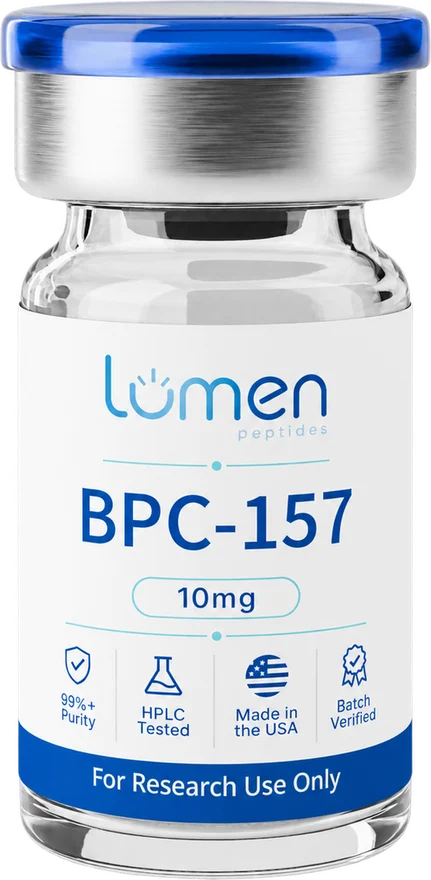

BPC-157 Research Compound: Identity, Purity and COA Verification Guide
Last updated:
BPC-157 is a synthetic peptide of 15 amino acids with the sequence GEPPPGKPADDAGLV. PubChem lists its molecular formula as C62H98N16O22 and its molecular weight as 1419.5 g/mol. To verify a research sample, check that its certificate of analysis (COA) reports HPLC purity, an MS mass matching the theoretical value, a lot number, a test date and the testing lab.
This guide is a reference card for laboratory buyers. It collects verified identifiers for BPC-157 in one table, explains how research material is supplied, walks through a COA field by field, and shows how to check an observed mass against theory. BPC-157 sold by Lumen Peptides is for in-vitro laboratory research only and is not for human or veterinary use.
What is BPC-157?
BPC-157 is a linear pentadecapeptide: a single chain of 15 amino acids joined by peptide bonds. The name is commonly expanded as "Body Protection Compound 157." PubChem records the compound under CID 9941957, with CAS Registry Number 137525-51-0 and synonyms that include Bepecin, PL-14736 and PLD-116 [1]. Material sold for research is made by chemical peptide synthesis.
The sequence, written from the N-terminus to the C-terminus, is [1]:
- Three-letter code: H-Gly-Glu-Pro-Pro-Pro-Gly-Lys-Pro-Ala-Asp-Asp-Ala-Gly-Leu-Val-OH
- One-letter code: GEPPPGKPADDAGLV
The "H-" and "-OH" mark a free N-terminal amine and a free C-terminal acid. The chain holds four prolines, three glycines, two alanines, two aspartic acids, and one each of glutamic acid, lysine, leucine and valine. Summing those residues plus one water gives C62H98N16O22, matching PubChem, so a different free-peptide formula on a supplier sheet is worth questioning.
BPC-157 has been studied in preclinical research, and a 2025 systematic review identified 36 published studies, of which 35 were preclinical and one was clinical [2].
BPC-157 compound data table
Each value comes from a primary chemical database or is calculated from one. Use it as the reference when reading a BPC-157 COA.
| Field | Value | Source |
|---|---|---|
| Name | BPC-157 (also written BPC 157) | PubChem CID 9941957 |
| CAS Registry Number | 137525-51-0 | PubChem CID 9941957 |
| Sequence (three-letter) | H-Gly-Glu-Pro-Pro-Pro-Gly-Lys-Pro-Ala-Asp-Asp-Ala-Gly-Leu-Val-OH | PubChem CID 9941957 |
| Sequence (one-letter) | GEPPPGKPADDAGLV | PubChem CID 9941957 |
| Length | 15 amino acids (linear) | Counted from the PubChem sequence |
| Molecular formula (free peptide) | C62H98N16O22 | PubChem CID 9941957 |
| Molecular weight (average) | 1419.5 g/mol | PubChem CID 9941957 (computed) |
| Monoisotopic mass | 1418.7042 Da | PubChem CID 9941957 (computed) |
| Acetate salt formula | C64H102N16O24 | PubChem CID 155977614 |
| Acetate salt molecular weight | 1479.6 g/mol | PubChem CID 155977614 |
| Theoretical [M+H]+ | 1419.7114 | Calculated: PubChem monoisotopic mass + 1 proton (NIST CODATA) |
| FDA approval status | Not FDA-approved | Vasireddi et al., 2025; FDA |
Research-grade form: lyophilized powder and salt forms
Research-grade BPC-157 is usually supplied as a lyophilized (freeze-dried) powder in a sealed vial. "Research grade" is a supplier term, not a regulatory standard, so the documentation behind a vial matters more than its label. The Lumen BPC-157 product page lists the specific material and its lot documentation.
Synthetic peptides are typically isolated as salts. PubChem holds a separate record for BPC-157 acetate (CID 155977614), with formula C64H102N16O24 and molecular weight 1479.6 g/mol [3]. That formula is the free peptide plus one molecule of acetic acid (C2H4O2). PubChem's synonym list for the parent compound also includes a trifluoroacetate (TFA) salt name [1].
Two practical consequences follow:
- Gross weight is not peptide weight. The fill weight of a vial includes counterion and any residual water. Bachem notes that peptides tend to be hygroscopic and that moisture absorbed from the atmosphere reduces overall peptide content [4]. Some COAs report net peptide content as a separate figure for this reason.
- The salt does not change the identity mass. Acetate is a counterion, not part of the peptide chain. Mass spectrometry identity is therefore checked against the free peptide (monoisotopic mass 1418.7042 Da), not against the 1479.6 g/mol salt weight.
What a BPC-157 COA should include
A certificate of analysis is the testing lab's record of what it measured in one specific lot. For BPC-157, a complete COA should contain the fields below.
| COA field | What to look for | Why it matters |
|---|---|---|
| Compound and sequence | BPC-157, with GEPPPGKPADDAGLV or the three-letter form | Confirms what the lab was asked to test |
| Lot or batch number | Identical to the number printed on your vial | A COA describes only the lot it names |
| HPLC purity | Percent area of the main peak, detection wavelength, and ideally the chromatogram | Shows the main component relative to other detected material under that method |
| MS identity | Observed mass, ion type or charge state, and the theoretical value used for comparison | Confirms the main peak is the expected peptide |
| Appearance | A physical description of the material, such as lyophilized powder and its color | A visible check you can repeat on receipt |
| Test date | Date of analysis, plus release date if different | Ties the results to a point in time |
| Testing laboratory | Lab name, whether it is independent of the seller, and an analyst or approver signature | Third-party testing separates the tester from the seller |
HPLC purity is a relative figure: the share of detected material in the main peak. It does not measure water or counterion, so purity and net peptide content are different numbers. An MS line that says only "conforms," with no observed value, cannot be checked independently.
Lumen Peptides publishes a third-party COA for every lot. Match the lot number on your vial to its certificate in the Lumen COA library before starting work.
How to check observed mass against theoretical mass
Step 1: Identify the mass type
Monoisotopic mass uses the most abundant isotope of each element; for BPC-157 it is 1418.7042 Da. Average molecular weight uses natural isotope abundances; for BPC-157 it is 1419.5 g/mol [1]. High-resolution instruments report monoisotopic values; some lower-resolution methods report average values. The two differ by about 0.8 units, so compare like with like.
Step 2: Account for charge state
Electrospray mass spectrometry usually detects protonated ions. The expected m/z for an ion carrying z protons is (M + z × 1.00728) / z, using the proton mass of 1.0072764666 u from NIST CODATA [5].
| Ion | Charge (z) | Theoretical m/z (monoisotopic) |
|---|---|---|
| [M+H]+ | 1 | 1419.7114 |
| [M+2H]2+ | 2 | 710.3594 |
| [M+3H]3+ | 3 | 473.9087 |
If a COA reports an average-mass [M+H]+, the expected value is about 1420.5 (1419.5 + 1.007).
Step 3: Calculate the error
Mass error in parts per million (ppm) = (observed − theoretical) / theoretical × 1,000,000. As an illustrative example only, not a Lumen lot result: an observed [M+H]+ of 1419.7140 against the theoretical 1419.7114 gives an error of about 1.8 ppm. Acceptance limits are set by the testing lab and depend on the instrument, so the COA should state either its tolerance or the theoretical value it used.
Common reasons a mass looks wrong
- Average and monoisotopic values mixed up. A gap of about 0.8 units usually means one side is average and the other is monoisotopic.
- Salt weight used as the reference. 1479.6 is the acetate salt weight, not an ion the instrument detects.
- Charge state misread. A peak near 710.36 is the doubly charged ion of the same molecule, not a different compound.
- Adducts. A sodium adduct, [M+Na]+, appears about 22 units above [M+H]+.
If none of these explains the gap, ask the seller for the raw spectrum and chromatogram.
Storing lyophilized BPC-157 research material
General lab practice for lyophilized peptides, as summarized in Bachem's handling guidelines [4]:
- Store the lyophilizate in a tightly closed container below −15 °C (5 °F). For long-term storage, −50 °C (−58 °F) or lower is preferred.
- Short-term storage in a refrigerator at 4 °C (39 °F) is acceptable.
- Let the container reach ambient temperature in a desiccator before opening, because peptides tend to be hygroscopic.
- Weigh out material quickly and reseal the container tightly.
Bachem also notes that peptides containing Asn, Gln, Met, Cys or Trp have limited shelf lives [4]. The BPC-157 sequence contains none of those residues, but the temperature and moisture guidance still applies. Log the lot number and receipt date, and file the matching COA with the sample record.
BPC-157 FAQ
What is the molecular weight of BPC-157?
PubChem lists the molecular weight of BPC-157 (free peptide, C62H98N16O22) as 1419.5 g/mol and its monoisotopic mass as 1418.7042 Da [1]. The BPC-157 acetate record lists 1479.6 g/mol [3].
What is the BPC-157 amino acid sequence?
GEPPPGKPADDAGLV in one-letter code, or H-Gly-Glu-Pro-Pro-Pro-Gly-Lys-Pro-Ala-Asp-Asp-Ala-Gly-Leu-Val-OH in three-letter code. It is a linear chain of 15 amino acids [1].
What should a BPC-157 COA include?
The compound name and sequence, a lot number that matches the vial, HPLC purity with method details, MS identity showing observed versus theoretical mass, appearance, test date, and the name of the testing lab. Lumen's lot certificates are in the COA library.
Is BPC-157 FDA approved?
No. BPC-157 does not have US Food and Drug Administration approval [2] and is not approved for human or veterinary use. FDA's page on bulk drug substances for compounding lists BPC-157 under "Bulk drug substances nominated but withdrawn" and states that the agency lacks sufficient safety information [6].
What does "research grade" BPC-157 mean?
It is a supplier designation, not a regulatory grade, indicating material sold for in-vitro laboratory research only. The practical evidence of quality is the lot-specific COA: HPLC purity, MS identity, test date and an independent testing lab.
Next step: match your lot to its COA
Compare the vial's lot number with its third-party certificate, then check the MS value against the tables above. Research compounds with published lot COAs are listed in the Lumen Peptides shop.
Research use only disclaimer
For in-vitro laboratory research use only. Not for human or veterinary use. All Lumen Peptides products, including BPC-157, are intended solely for qualified researchers conducting in-vitro laboratory studies. They are not intended to diagnose, treat, cure or prevent any disease and must not be administered to humans or animals. This article provides chemical reference and quality-verification information only. It is not medical advice and does not describe or endorse any use. Purchasers are responsible for handling and disposing of research materials in line with applicable laws and institutional safety requirements.
References
- National Center for Biotechnology Information. PubChem Compound Summary for CID 9941957, Bpc-157. https://pubchem.ncbi.nlm.nih.gov/compound/9941957
- Vasireddi N, Hahamyan H, Salata MJ, Karns M, Calcei JG, Voos JE, Apostolakos JM. Emerging Use of BPC-157 in Orthopaedic Sports Medicine: A Systematic Review. HSS J. 2025;21(4):485-495. doi:10.1177/15563316251355551. PMID 40756949. https://pubmed.ncbi.nlm.nih.gov/40756949/
- National Center for Biotechnology Information. PubChem Compound Summary for CID 155977614, BPC-157 acetate. https://pubchem.ncbi.nlm.nih.gov/compound/155977614
- Bachem. Handling and Storage Guidelines for Peptides. Bachem Knowledge Center. https://www.bachem.com/knowledge-center/handling-and-storage-guidelines-for-peptides/
- National Institute of Standards and Technology. CODATA Value: proton mass in u. https://physics.nist.gov/cgi-bin/cuu/Value?mpu
- US Food and Drug Administration. Certain Bulk Drug Substances for Use in Compounding that May Present Significant Safety Risks. Content current as of 04/22/2026. https://www.fda.gov/drugs/human-drug-compounding/certain-bulk-drug-substances-use-compounding-may-present-significant-safety-risks